See why CT scanning stands out as the only inspection method for internal defects and geometries in additive manufacturing
Over 60% of complex additive manufacturing (AM) components contain internal features. Lattice structures and enclosed channels cannot be fully measured or validated using traditional metrology tools. This article outlines how engineers and quality professionals can accurately inspect these geometries using advanced solutions like industrial CT scanning. The guidance is based on established metrology practices, real-world inspection case studies, and performance criteria aligned with ISO standards for dimensional verification.
Not using CT creates a measurable risk:
For engineers focused on compliance, reliability, and performance, this is not a tooling limitation; it is a fundamental inspection gap that requires CT scanning for complete defect detection and internal geometry inspection.
Finding defects in additive manufacturing can be an important step throughout the process.
These defects are often:
This is where most inspection strategies fail, and CT scanning dominates.
Computed Tomography (CT) scanning is different from traditional inspection methods because it uses X-ray technology to build complete volumetric data.
Traditional measuring tools are limited to surface data, while CT scanning reconstructs the entire 3D internal and external geometry of a part.
If you'd like to learn more, take a look at this guide to CT scanning.
Other methods rely on:
With CT scanning, you don’t have to compromise.

Lattice structures are one of the most powerful advantages of additive manufacturing. This also makes them one of the most difficult to inspect.
Without CT scanning, these structures are effectively unverifiable.
Internal channels, cooling passages, and fluid pathways are increasingly common in aerospace and medical AM parts now. They also introduce new inspection needs.
A partially blocked internal channel:
CT scanning provides direct validation of internal geometry, eliminating guesswork.
For high-performance applications like aerospace propulsion, defect detection in additive manufacturing isn’t optional—it’s mission-critical.
In a recent project, Inspecting 3D Printed Rocket Components with Industrial CT Scanning demonstrated how CT scanning additive manufacturing workflows can uncover defects that would otherwise remain undetected until failure.
3D printed rocket components often include:
Traditional inspection methods simply cannot access or validate these features, creating significant risk.
Using industrial CT scanning, engineers were able to:
The scan data enabled:
If you cannot inspect internal geometries, you cannot fully validate the part.
Spotting a defect alone isn’t enough. Engineers need quantifiable data to make decisions that matter.
This transforms CT scanning from an inspection tool into a decision-making platform.
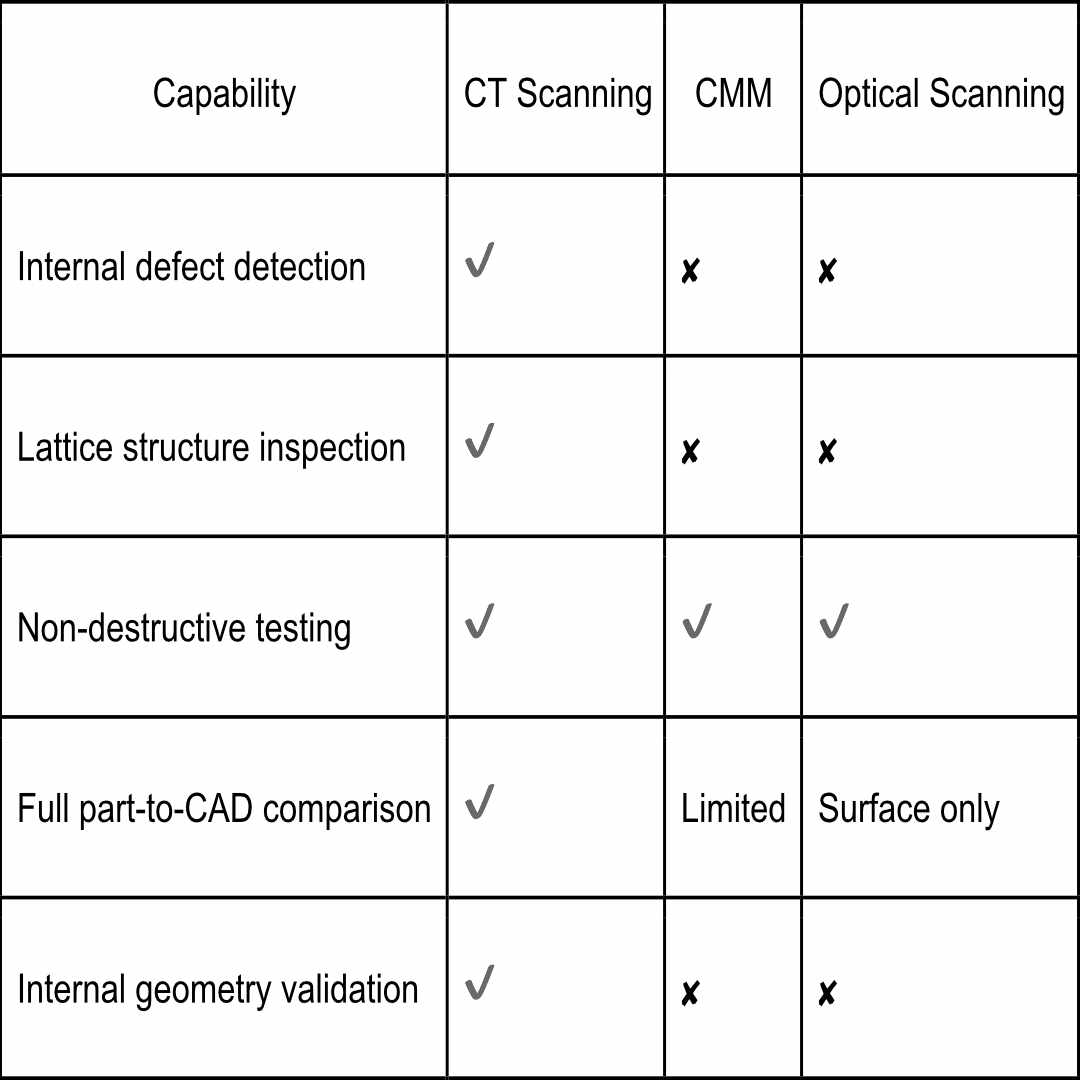
👉 For challenging additive manufacturing geometries, CT scanning is not just better—it’s the only complete solution.
CT scanning is essential when:
CT scanning detects:
Because it provides full internal and external visibility. It can detect defects that cannot be located using traditional inspection methods.
Yes. CT scanning is the only non-destructive method able to fully inspect lattice structures. This includes internal struts and node connections.
CMMs measure external surfaces with high accuracy, but cannot access internal geometries. CT scanning captures full volumetric data for a complete and thorough inspection.
Additive manufacturing lets you create things that would have been difficult before. With that freedom comes new challenges and risk.
Inspection tools must match modern designs.
CT scanning is built for today’s AM reality:
Complex AM parts demand rock-solid validation.
If your design relies on internal features, lattices, or needs absolute reliability, CT scanning is not optional—it’s foundational.
Get clarity and a data-driven understanding of your parts. Request a CT scan evaluation today.

Victoria is the Creative Marketing Manager at Nel PreTech Corporation. She takes complex topics, like industrial CT scanning and 3D engineering, and turns them into accessible content for engineers and decision-makers. With a strategic communication background, she's helped Nel PreTech become a go-to partner in precision measurement and digital manufacturing. Off the clock, you’ll probably find her on a snowboard or hunting down the best tacos in town. She's not afraid to carve her own path!


You'll find all the detailed service information you need in one brochure.
Download Brochure
Get a quote within 24-hours and keep your project on schedule.
Get a Quote
Our Nel PreTech engineers are ready to get started on your product challenges.
Ask an Engineer
Download the ultimate CT Scanning Buyer's Guide to improve understanding, time, and efficiency in your scanning needs. Over 50 Pages of useful data and case studies.
Download Now