Learn how CT scanning uncovers EV battery voids, weld defects, and tab faults to improve safety, performance, and quality.
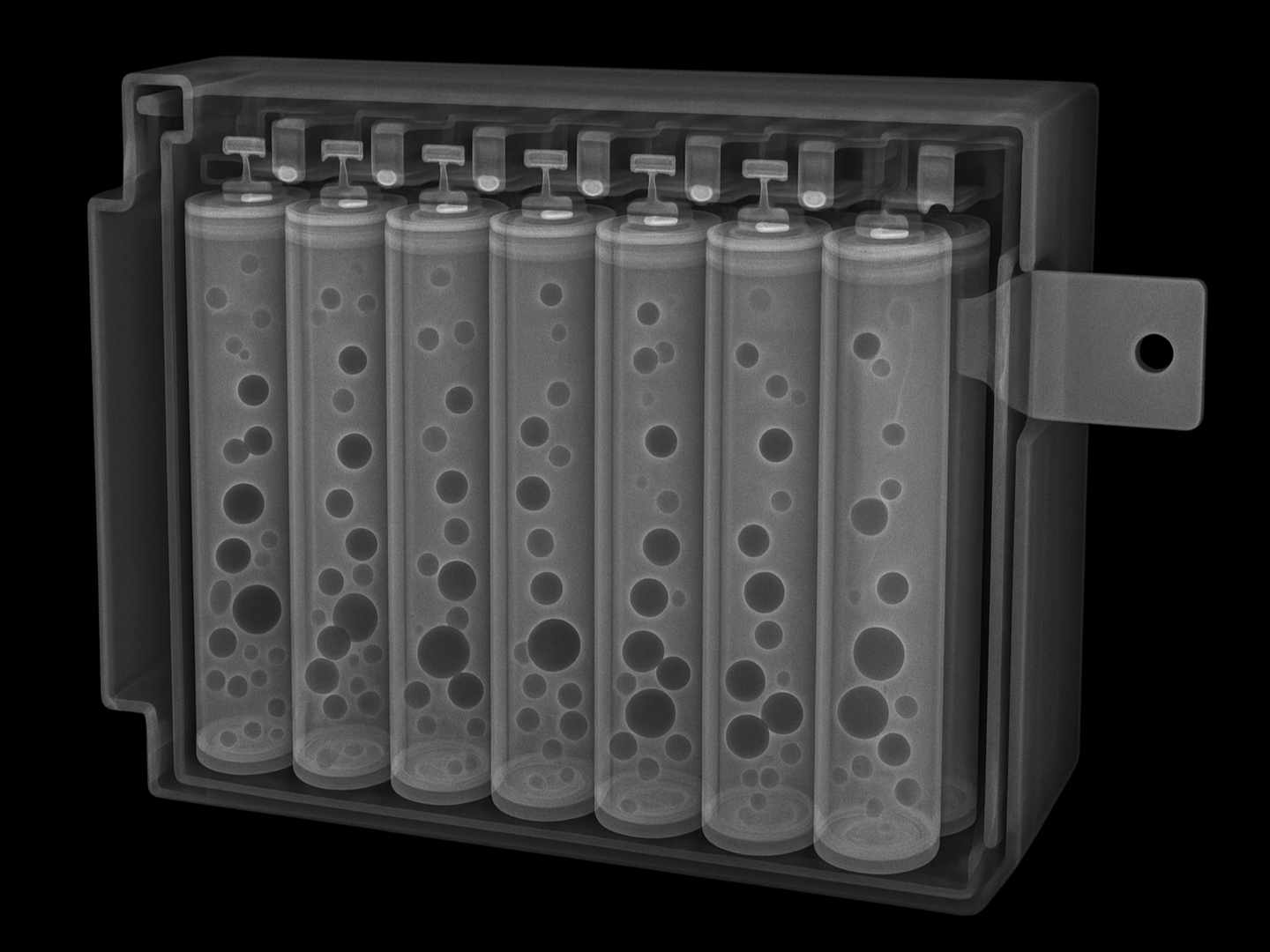
The demand for safer, longer-lasting, and more energy-efficient batteries continues to rise as electric vehicle (EV) production grows worldwide. Ensuring the safety of batteries requires having accurate visibility of internal structures, which cannot be done through traditional inspection methods. This is where EV battery CT scanning has reshaped the industry.
CT technology delivers thorough, non-destructive imaging of EV cells, modules, and full battery packs, helping manufacturers to identify voids, weld difficulties, tab flaws, and structural anomalies before they become performance or safety hazards.
This guide explains how CT scanning enhances battery inspection, why it’s essential for modern EV quality assurance, and how advanced imaging strengthens reliability across the full battery lifecycle.
Battery manufacturing is a highly complex operation that requires precision in all stages, such as electrode coating, stacking, winding, welding, electrolyte filling, and sealing. Tiny internal inconsistencies can lead to:
The use of industrial CT (computed tomography) for battery scanning is the central quality control measure that stems from this. CT technology generates precise 3D volumetric images; thus, engineers get the opportunity to see the inner parts without opening or damaging the battery. This non-destructive method is the best choice for both R&D and production-scale verification.
Internal voids or density inconsistencies within electrode coatings or separator layers can significantly reduce battery efficiency and cycle life. CT scanning allows engineers to identify issues such as:
These defects disrupt ion flow, create localized resistance, and can eventually lead to hotspots and accelerated degradation.
The phrase "battery defects" refers to various kinds of differences in the structure of the cells. With the help of CT scans, engineers can see the following problems:
Any one of these components may lead to a decrease in safety, trustworthiness, and heat stability.
Laser welding and ultrasonic welding are widely used to join cell terminals, busbars, and structural components within EV modules and packs. However, poor weld quality is one of the leading causes of battery failures. CT scanning provides detailed weld-level visibility, allowing engineers to detect defects such as:
Strong and uniform welds, a requirement for electrically conductive and mechanically strong high-voltage batteries, make CT data very important in weld verification.
Tabs serve as the electrical highways through which the current flows from one cell to the next in a battery module. When tabs are weak or have been put together in a faulty way, the battery may heat up, the current may not be distributed evenly, or there may be shorts inside the battery.
By using CT scanning to examine batteries, it is possible to identify various defects in tabs, such as:
The knowledge gained here is very valuable for the company as it helps them to fine-tune their product design and have better command over the manufacturing process.
In the R&D period, a team uses CT for analysis of the cell design, confirmation of the use of new materials, and the improvement of manufacturing processes.
Through CT scanning, every batch is checked to be in compliance with the most stringent safety standards that are necessary for automotive-grade batteries.
When a battery fails, CT scanning gives an accurate 3D representation of its interior structure, enabling engineers to identify the underlying problem without cutting or injuring the device. It is a non-destructive approach that keeps the batteries to be utilized in future research and facilitates proper and evidence-based diagnosis.
By comparing battery technologies side by side, companies may improve the performance of their own goods.
As EV adoption accelerates, the demand for higher battery safety, consistency, and reliability continues to rise. EV battery CT scanning has turned out to be a key element due to the fact that it can fully and non-destructively view cells, modules, and packs ensuring that the process can identify the presence of a void, structural defects, weld issues and tab faults long before they can impact performance or become safety concerns.
Advanced CT inspection can help manufacturers, researchers, and automotive suppliers to enhance accuracy, as well as, increase quality control. NPC provides high-resolution visuals and profound knowledge about EV battery systems, making it a reliable partner for achieving today's stringent safety and performance requirements.
By selecting NPC for your next battery scanning project, you will have the much needed clarity, accuracy, and confidence required to create safer and dependable EV battery designs.

Victoria is the Creative Marketing Manager at Nel PreTech Corporation. She takes complex topics, like industrial CT scanning and 3D engineering, and turns them into accessible content for engineers and decision-makers. With a strategic communication background, she's helped Nel PreTech become a go-to partner in precision measurement and digital manufacturing. Off the clock, you’ll probably find her on a snowboard or hunting down the best tacos in town. She's not afraid to carve her own path!


You'll find all the detailed service information you need in one brochure.
Download Brochure
Get a quote within 24-hours and keep your project on schedule.
Get a Quote
Our Nel PreTech engineers are ready to get started on your product challenges.
Ask an Engineer
Download the ultimate CT Scanning Buyer's Guide to improve understanding, time, and efficiency in your scanning needs. Over 50 Pages of useful data and case studies.
Download Now