Learn how 3D dimensional inspection verifies GD&T compliance, surface deviation, and production-level tolerance validation in advanced manufacturing.
When it comes to controlled manufacturing, formal standards for tolerance verification are regulated by ASME Y14.5 (Geometric Dimensioning and Tolerancing) and the ISO GPS system (ISO 1101). These standards focus on geometrical relationships instead of just single-point measurements. They describe how features, datums, and surfaces connect in three-dimensional space.
Lighter aerospace components, smaller medical parts, and complex internal shapes have made tolerance verification trickier than ever. Discrete measurement techniques typically cannot be used to verify full-surface profile tolerances, complex datum structures, or cumulative geometric relationships.
That’s why engineering leaders and quality managers rely on 3D Dimensional Inspection, supported by essential 3D Scanning Services, as an essential validation tool. It ensures production meets technical requirements and passes audits with confidence.
Modern manufacturing is filled with:
ASME Y14.5 sets out tolerances like surface profile, true position, flatness, and runout; all volumetric geometric requirements. Validating these conditions through limited point sampling can introduce uncertainty, particularly when surfaces are organic or non-linear.
In advanced manufacturing, tolerance verification isn’t about spot-checking a few features. You need to capture the entire geometric condition. Industrial 3D Scanning Services deliver full surface data, supporting every level of this dimensional rigor.
Classic metrology tools like calipers and coordinate measuring machines (CMMs) remain highly precise for prismatic and accessible features. However, limitations arise when
Point-based measurements only sample the geometry. If tolerances cover whole surfaces, you could easily miss localized deviations.
3D Dimensional Inspection closes this gap by capturing millions of data points and producing a true digital model of the actual part. That means engineers can make a comprehensive evaluation rather than cherry-pick points.
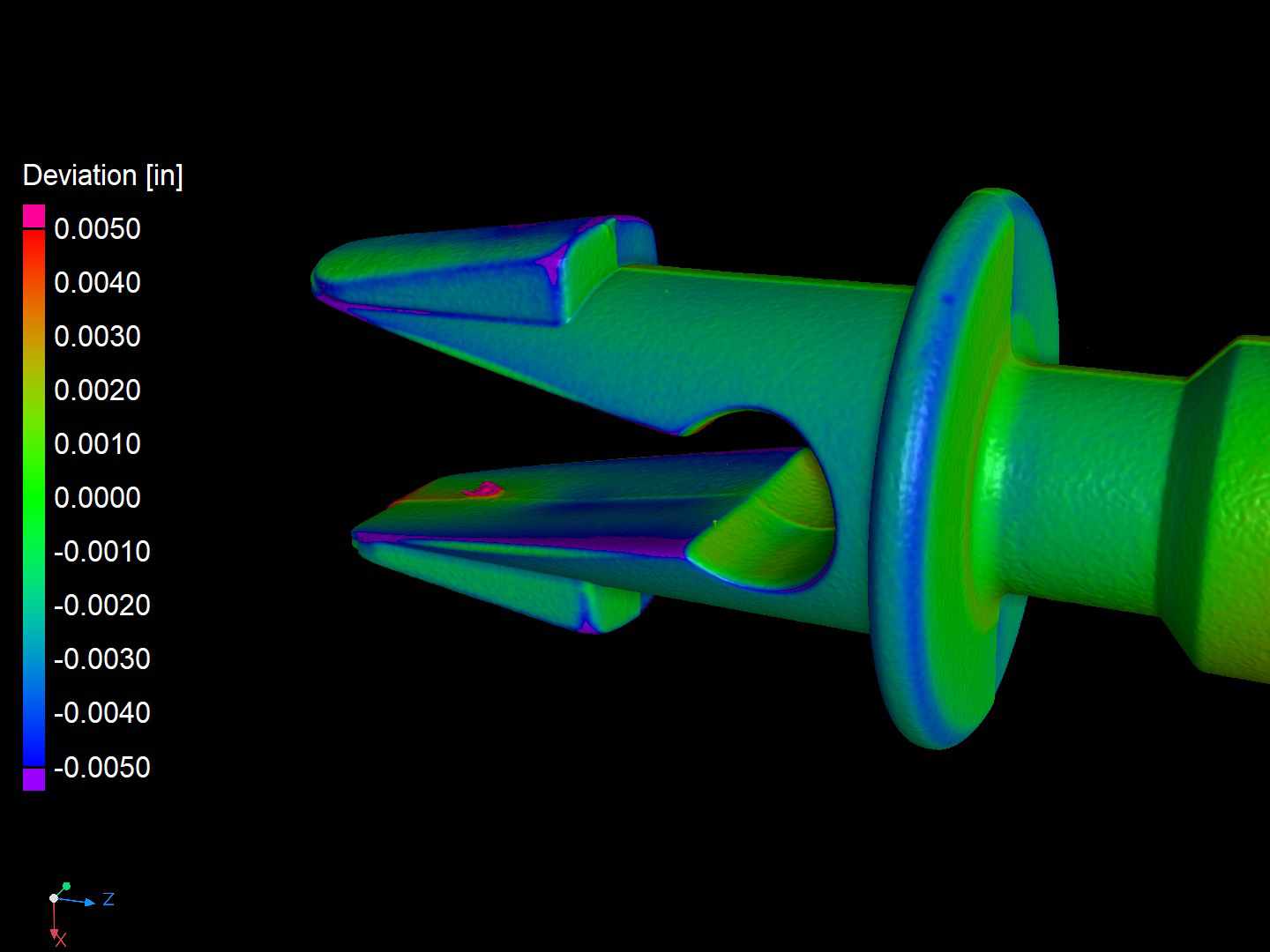
One of the most significant advantages of Industrial 3D Scanning Services is the ability to map out scanned parts against CAD models. After scanning, the measured dataset is aligned with the nominal CAD geometry using defined datum structures consistent with the drawing requirements.
The inspection software checks:
Deviation color maps highlight how each section stacks up against specs. Numerical reports offer objective, traceable evidence.
For freeform aerospace components, molded housings, turbine components, or intricate medical assemblies, full-surface verification is the only way to guarantee design intent.

First Article Inspection (FAI) is all about proving a manufacturer can produce parts within tolerance limits. This documentation in regulated industries should be objective, reproducible, and audit-proof.
3D Scanning Services help FAI by:
As production grows, scanning workflows can detect subtle geometric shifts between batches. This supports quality control and process validation over the long haul.
Aerospace, medical, and defense manufacturing face strict demands. Dimensional data must be traceable and compliant. Inspection processes must operate within controlled laboratory environments with protocols for:
Industrial 3D Scanning Services are most effective when conducted within structured inspection environments that follow recognized laboratory standards.
Nel Pretech aligns our 3D dimensional inspection processes with ISO/IEC 17025 laboratory principles governing technical competence and measurement control. As part of its ongoing quality system development, NPC undergoes the A2LA accreditation audit process to further cement traceability, uncertainty validation, and laboratory controls. This structured approach strengthens confidence and keeps inspections tight without straying from the core purpose.
ASME Y14.5 and ISO GPS standards lay out tolerances as three-dimensional geometric requirements. As manufacturing gets more complex, checking these with inspection systems that capture the full geometry is non-negotiable.
3D Dimensional Inspection delivers:
When you bring disciplined laboratory workflows into play, Industrial 3D Scanning Services strengthen manufacturing validation, safeguard compliance, and reduce risk associated with geometric misinterpretation.
For organizations evaluating advanced tolerance verification solutions, faster measurement is top-of-mind. However, maintaining defensible dimensional data that supports compliance, production scaling, and long-term reliability should be as well.
If your team is thinking about 3D Scanning Services for GD&T verification, tough-geometry inspection, or production validation, reach out to Nel Pretech. We’ll discuss how 3D dimensional inspection workflows can boost your quality and manufacturing goals.

Jason Johnson is a senior technical leader at Nel PreTech Corporation with degrees in Electrical Engineering (UIC) and Computer Science (Governor’s State University). He oversees CMM, Vision, CT, and Blue Light scanning operations and serves as Quality Manager, maintaining ISO 17025 accreditation. With more than two decades at Nel PreTech, Jason brings deep expertise across metrology, quality systems, and technical operations.


You'll find all the detailed service information you need in one brochure.
Download Brochure
Get a quote within 24-hours and keep your project on schedule.
Get a Quote
Our Nel PreTech engineers are ready to get started on your product challenges.
Ask an Engineer
Download the ultimate CT Scanning Buyer's Guide to improve understanding, time, and efficiency in your scanning needs. Over 50 Pages of useful data and case studies.
Download Now