
+
WEBINAR: Unlock the Power of Industrial CT Scanning
See Deeper. Solve Faster. Spend Smarter.
A 1/2 Hour That Could Reshape Your Inspection Strategy
Date: Wed June 18, 2025
Time: 11am Central Time
Location: Live Online Webinar
See Deeper. Solve Faster. Spend Smarter.
A 1/2 Hour That Could Reshape Your Inspection Strategy
Date: Wed June 18, 2025
Time: 11am Central Time
Location: Live Online Webinar
See Deeper. Solve Faster. Spend Smarter.
A 1/2 Hour That Could Reshape Your Inspection Strategy
Date: Wed June 18, 2025
Time: 11am Central Time
Location: Live Online Webinar
Read how advanced inspection verifies dimensional accuracy and internal geometry in additively manufactured firearm suppressors.
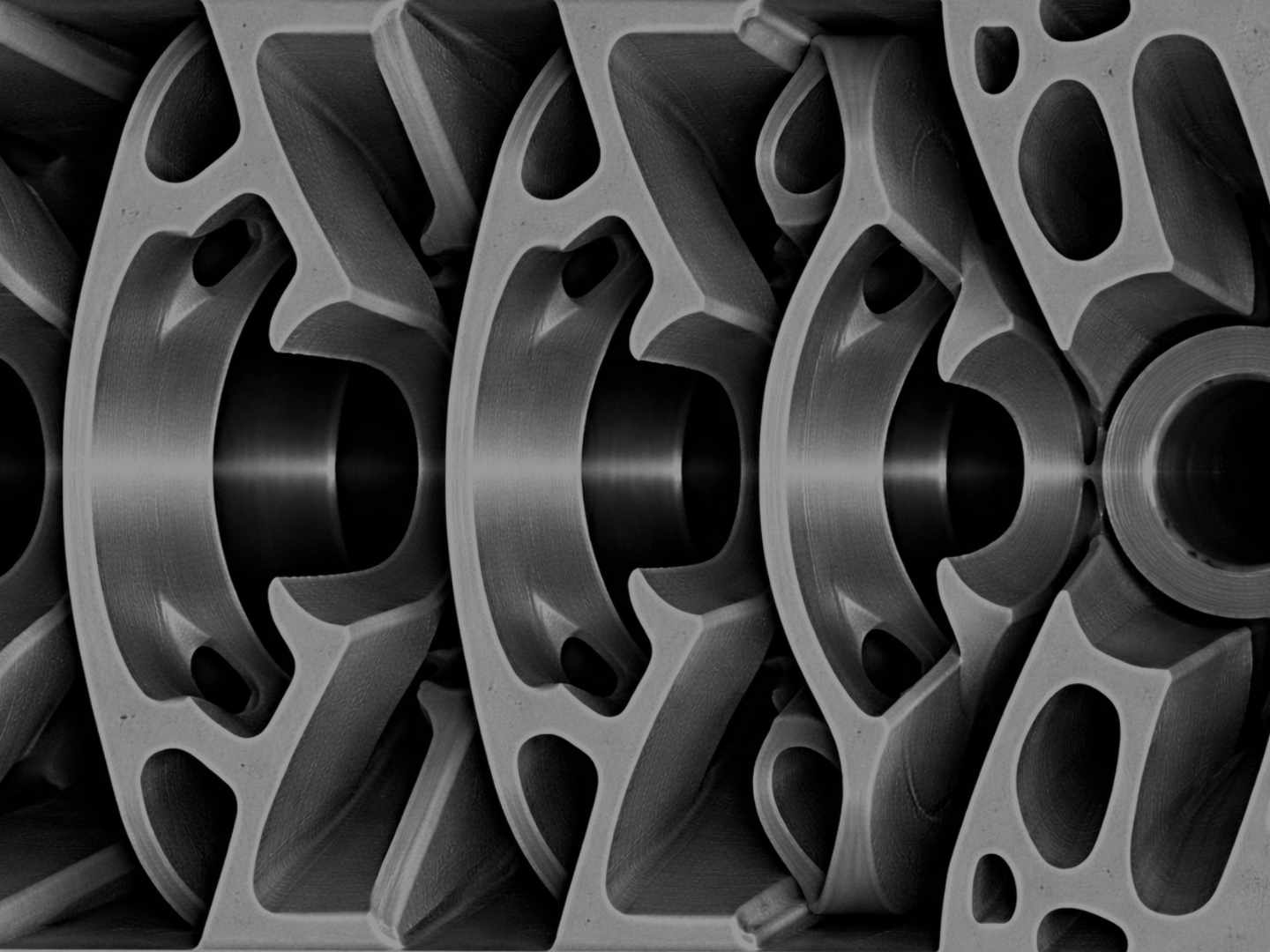
Making firearm parts isn’t just about cutting metal or shaping plastic. There’s a great deal of responsibility under strict regulations. Quality checks aren’t just something you tack on at the end. They’re baked into every step. When you’re dealing with regulated parts, you have to check every detail: dimensions, material consistency, process stability. The paperwork needs to be rock solid—no gaps, nothing left to chance. Additive manufacturing cranks up the challenge even more. Internal shapes get complex, processes shift, and you can’t just eyeball the results. You need advanced tools to verify everything is up to standard.
Gun parts inspection services are essential in authenticating these components before advancing them into qualification, production, or compliance audit. Perhaps the most challenging case is 3D-printed firearm suppressors, whose inspection falls beyond the normal scope of traditional metrology.
When you look at 3D-printed firearm suppressors from a manufacturing angle, it’s all about those tricky internal shapes, thin walls, and the need to keep every measurement just right. Additive manufacturing, particularly direct metal laser sintering (DMLS), opens the door to designs impossible to achieve with traditional machining or forming. There is a caveat to that freedom; if you don’t pick the right inspection method, you can miss something important.
The real challenge? Internal channels, lattice work, closed-off spaces, and features that twist in multiple directions. They’re often impossible to reach with traditional touch-based measuring tools. Just checking the outside isn’t enough. You have to inspect both what you can see and what’s hidden inside, since both matter for making sure the part fits specs and the material holds up.
And when you’re dealing with regulated firearm parts, inspection isn’t really about whether the thing works. It’s about proving the part matches its approved design and documented specs, down to the last detail.
Additively manufactured suppressor components cannot be inspected with traditional inspection tools like calipers and gauges, or restricted optical systems. These parts require inspection techniques capable of evaluating internal geometry, detecting subsurface conditions, and validating dimensional accuracy across the entire volume.
Advanced inspection methods commonly applied include:
Computed tomography enables inspection teams to scan both internal and external features in a single scan, which is non-destructive and provides traceable datasets that would be used in quality reporting, first article inspection (FAI), and process validation.
Additive manufacturing introduces specific quality risks that must be addressed during inspection. These risks are manufacturing-related and independent of part application.
Internal Voids and Porosity
Localized voids or unintended porosity can form due to powder distribution, laser parameters, or thermal gradients. CT inspection allows these characteristics to be detected without sectioning the part.
Surface Roughness and Internal Finish Variation
As-printed surfaces may exhibit roughness or partially fused material, particularly within enclosed internal passages. Although surface texture is a manufacturing-level outcome, it is checked by inspection to show that such conditions do not exceed the limits provided.
Dimensional Deviation and Distortion
Thermal stresses during printing and post-processing can introduce distortion or dimensional drift. Full-field CT and 3D metrology give an opportunity to compare nominal Scan to CAD services via geometry and the as-built parts.
Material Consistency and Layer Integrity
Layer-to-layer inconsistencies, lack of fusion, or density variation can be identified through volumetric imaging and density analysis.
Each of these issues represents a potential nonconformance that inspection services are designed to detect early and document accurately.
For regulated firearm components, inspection is not limited to pass/fail evaluation. The primary objectives include:
The inspection data should be objective, reproducible, and defensible. Non-destructive methods are especially useful as they do not affect the part's integrity and allow seeing the full picture of manufacturing results.
As a laboratory specializing in advanced inspection and industrial CT scanning, Nel Pretech supports regulated manufacturers with non-destructive inspection services designed for complex, high-risk components. NPC’s capabilities are aligned with industries where internal geometry, tight tolerances, and documentation accuracy are critical.
Inspection services commonly applied to additively manufactured firearm components include:
Every inspection workflow here actually puts compliance, data integrity, and confidentiality front and center.
If you’re inspecting 3D-printed firearm suppressors, you need a manufacturing-driven approach. That means using non-destructive testing, careful dimensional checks, and thorough documentation. Additive manufacturing lets you create wild, complex shapes inside these parts, so inspection techniques have to see everything—outside and inside—to make sure you’re hitting all the qualification and compliance marks.
High-end gun parts inspection services give manufacturers real confidence. They prove parts meet the standards, cut down on inconsistencies, and keep regulated production solid. When your inspection data is spot-on, repeatable, and stands up to scrutiny, you’re not just checking boxes—you’re building a stable, reliable quality system that lasts.
Nel Pretech brings years of hands-on experience with industrial CT scanning and dimensional inspection for regulated components. We help manufacturers dealing with additively manufactured firearm parts by providing precise, non-destructive looks into even the most complex geometries. Our lab helps you get inspection-ready, keep your documentation airtight, and stay right in line with regulations.
Send a part print for feasibility review.

Carter Aldridge is a youthful injection to the Nel Pretech team, bringing a can-do attitude, infectious curiosity, and an out-of-the-box thought process. Carter is one of Nel Pretech’s CT specialists and a Sr. Applications Engineer.


You'll find all the detailed service information you need in one brochure.
Download Brochure
Get a quote within 24-hours and keep your project on schedule.
Get a Quote
Our Nel PreTech engineers are ready to get started on your product challenges.
Ask an Engineer
Download the ultimate CT Scanning Buyer's Guide to improve understanding, time, and efficiency in your scanning needs. Over 50 Pages of useful data and case studies.
Download Now

