Learn how industrial CT scanning helps lithium-ion battery makers identify defects, improve processes, and increase battery reliability.
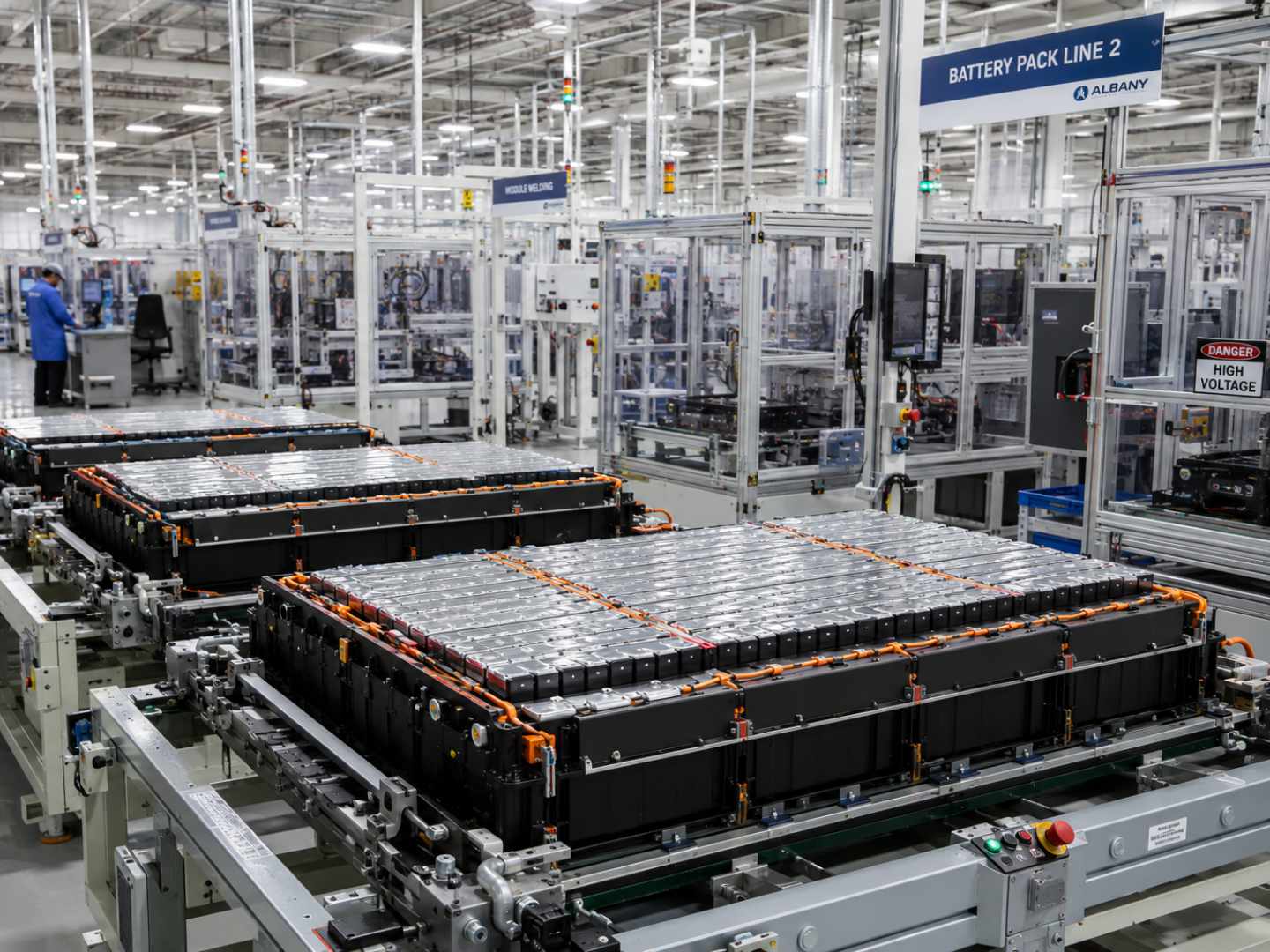
Lithium-ion battery manufacturing leaves very little room for variance. Even minuscule inconsistencies in electrode placement, weld quality, separator integrity, or material distribution can impact electrical performance, thermal behavior, cycle life, and long-term reliability.
These problems show up beneath the outer casing. Conventional inspection methods provide limited visibility. External measurements cannot fully characterize the internal condition of a completed cell.
Battery CT scanning services provide a non-destructive evaluation of internal architecture. Engineers can identify hidden flaws and validate assembly without cutting into the product. It enables internal visualization of features in three dimensions. In turn, defect severity and manufacturing consistency can be determined across cells, modules, and units. Download Nel PreTech Corporation's battery CT scanning brochure to learn more.
As EV platforms, aerospace electrification programs, and energy storage systems continue pushing battery performance higher, manufacturers are relying more heavily on internal inspection data to support quality control and process stability.
Modern lithium-ion batteries are densely packed electrochemical systems. They contain layered electrodes, separators, current collectors, welds, tabs, and electrolyte pathways; all assembled within narrow tolerance windows.
Small process deviations during manufacturing can create defects influencing:
In high-volume manufacturing, identifying issues is typically tied to process variation rather than catastrophic assembly failures. Identifying subtle internal inconsistencies early allows process drift correction before larger quality problems emerge.
Destructive sectioning can provide useful information, but ruins the sample and reveals only a limited cross-sectional view. Industrial CT scanning sets the engineer up to inspect the entire internal structure while preserving the unit. This is beneficial for additional testing or validation work.
Industrial CT systems generate a volumetric dataset of the battery interior using thousands of radiographic projections reconstructed into a high-resolution 3D model.
Unlike standard X-ray imaging, CT inspection enables engineers to evaluate internal structures spatially rather than through a single compressed image plane.
Depending on the battery design and scan resolution, CT inspection may be used to analyze:
This level of visibility makes CT particularly useful for process validation, prototype development, failure analysis, and advanced quality investigations.
Electrode positioning directly affects active material utilization and current distribution throughout the cell.
In cylindrical, pouch, and prismatic cells, alignment anomalies can create localized performance inconsistencies or increase stress concentrations during cycling.
CT scanning allows engineers to evaluate:
These inspections are especially valuable during process setup and pilot production, where manufacturers are refining assembly parameters and validating repeatability.
Instead of relying solely on destructive teardown analysis, engineers can compare multiple production samples nondestructively and identify trends before scaling output.
Void formation remains one of the more common manufacturing concerns in lithium-ion battery production.
Porosity may develop from trapped gas, incomplete material consolidation, inconsistent filling processes, or welding-related conditions. While some voiding may be acceptable depending on location and severity, concentrated defects near critical interfaces can influence both structural and electrical behavior.
CT inspection helps manufacturers characterize:
Besides confirming if porosity exists, CT data provides engineering teams with the information needed to determine if the defect is isolated, systemic, or process-related.
This distinction becomes important when optimizing manufacturing parameters or validating supplier quality.
Separator integrity is a primary characteristic for lithium-ion battery safety and performance.
Wrinkling, delamination, or localized displacement can alter ion transport behavior and potentially increase thermal risk under demanding use conditions.
Many separator-related issues are difficult to evaluate externally because the affected layers remain embedded within the completed cell structure.
CT scanning provides insight into:
For failure analysis investigations, this can help engineers determine whether internal mechanical changes developed during manufacturing or evolved later during operation and testing.
Electrical connection has a direct bearing on resistance, thermal generation, and long-term reliability.
Battery manufacturers will use CT scanning to evaluate laser welds, ultrasonic welds, and tab connections. Destructive inspection would otherwise remove critical evidence.
CT analysis may reveal:
As battery architectures become more compact and power-dense, access to internal connection points becomes increasingly limited. CT scanning provides a way to evaluate these areas without disassembling the assembly.
This capability is useful during process optimization and root cause investigations involving inconsistent power delivery.
Battery CT inspection is not limited to a single phase of production. Manufacturers can use CT data throughout development, validation, and post-production workflows.
During battery design and prototype evaluation, CT scanning helps teams confirm internal geometry, compare design iterations, and identify manufacturing risks before scaling production.
As production transitions from prototype to pilot scale, CT inspection supports process refinement by verifying assembly consistency and identifying early-stage process instability.
In manufacturing environments, CT scanning is frequently used for targeted quality investigations, defect characterization, and validation of corrective actions.
Rather than functioning solely as a pass/fail inspection tool, CT often serves as an engineering diagnostic tool for understanding why defects are happening.
When batteries exhibit abnormal electrical, thermal, or mechanical behavior, CT scanning provides internal access before teardown analysis begins.
This preserves valuable evidence and allows engineers to correlate internal conditions with electrical test data, thermal events, or mechanical damage.
Battery manufacturers in the U.S. are under pressure to improve reliability while scaling production volumes and energy density concurrently.
As cell architectures become more complex, internal inspection data is becoming more important for:
For EV battery development, aerospace power systems, consumer electronics, or energy storage technologies, CT inspection has become an increasingly important tool for understanding how manufacturing conditions influence final product quality.
Many battery defects originate internally long before measurable performance issues appear externally. Identifying those conditions early requires inspection methods capable of evaluating the full internal structure nondestructively.
Industrial CT scanning gives manufacturers the ability to analyze hidden defects, validate assembly quality, and investigate failure mechanisms with significantly greater detail than conventional inspection methods alone.
At Nel PreTech Corporation, industrial CT scanning services support advanced manufacturing quality initiatives across battery development, process validation, and failure analysis applications. From internal defect characterization to production troubleshooting, CT inspection provides engineering teams with actionable data that supports better manufacturing decisions and improved long-term reliability.

Victoria is the Creative Marketing Manager at Nel PreTech Corporation. She takes complex topics, like industrial CT scanning and 3D engineering, and turns them into accessible content for engineers and decision-makers. With a strategic communication background, she's helped Nel PreTech become a go-to partner in precision measurement and digital manufacturing. Off the clock, you’ll probably find her on a snowboard or hunting down the best tacos in town. She's not afraid to carve her own path!


You'll find all the detailed service information you need in one brochure.
Download Brochure
Get a quote within 24-hours and keep your project on schedule.
Get a Quote
Our Nel PreTech engineers are ready to get started on your product challenges.
Ask an Engineer
Download the ultimate CT Scanning Buyer's Guide to improve understanding, time, and efficiency in your scanning needs. Over 50 Pages of useful data and case studies.
Download Now